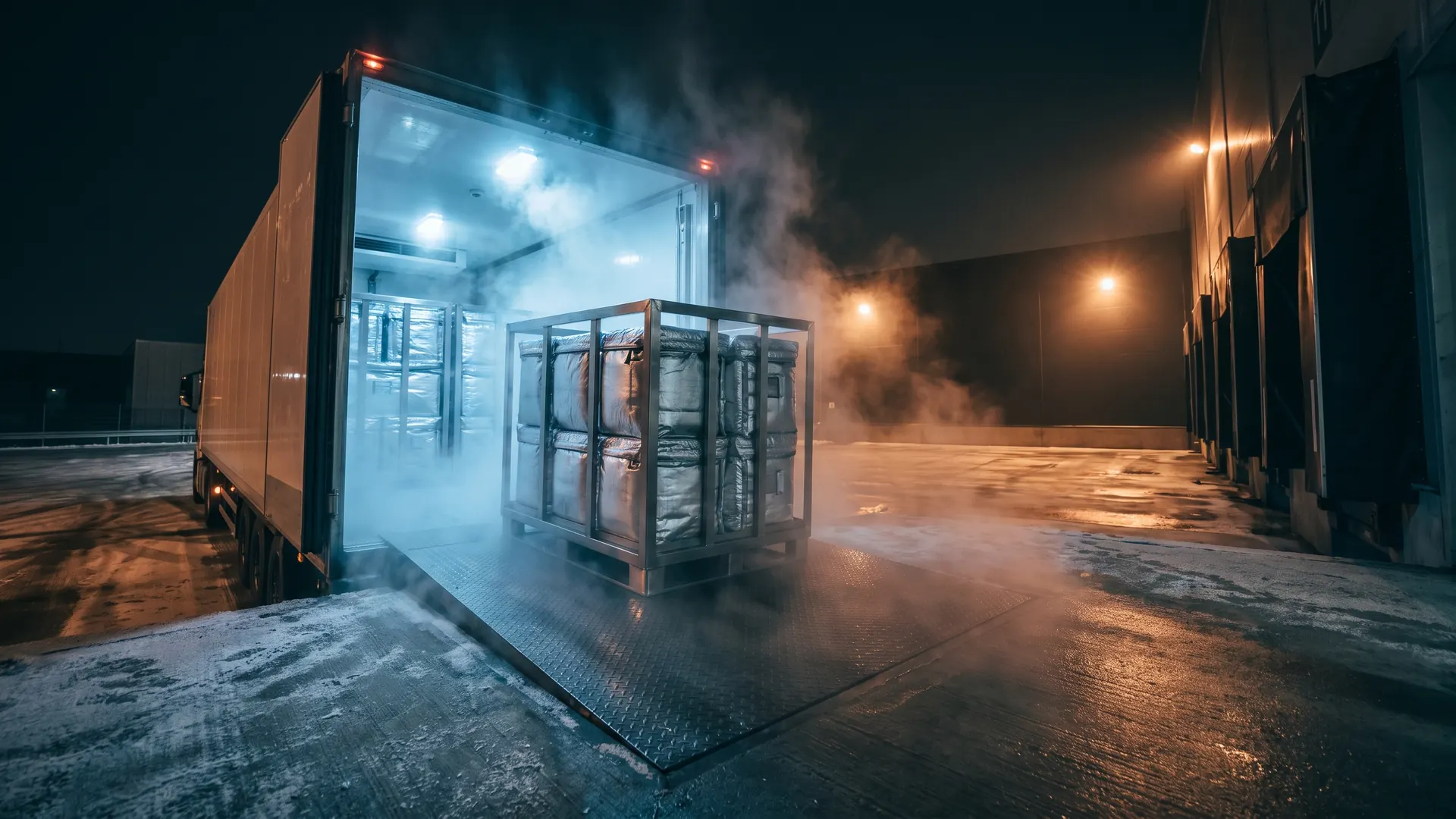
Pillar · Cold Chain
Cold chain logistics for pharma, biotech and perishables
Validated 2-8°C operation, ultra-low temperature, and sensor-to-sensor traceability for medicines, vaccines, biologics, perishables and medical devices.
What we keep under control
What we keep under control on every shipment
A cold chain shipment isn't just "a truck with air conditioning." We control temperature, relative humidity, time out of allowed range, thermal packaging integrity, and the documentary chain of custody — because in pharma, proof that the product stayed within range is worth as much as the product itself. If your quality auditor can't reconstruct a batch's complete thermal history, that batch is a risk regardless of whether it arrived physically intact.
Controlled 2-8°C
Cold rooms, reefer vehicles and validated active packaging.
Ultra-low temperature
-20°C, -70°C and dry ice operation for biologics and sensitive samples.
Sensor-to-sensor traceability
IoT data loggers, automatic alerts and excursion reporting per shipment.
Vaccines and biologics
Specialized handling from origin to the destination lab or vaccination site.
COFEPRIS compliance
Sanitary permits, authorized imports and origin documentation.
Good Distribution Practices
Auditable procedures under international GDP standards.
Temperature ranges we operate
Each range demands different equipment, packaging and monitoring. Quoting without specifying your product's real range is the most common cause of overpaying — or worse, of a temperature excursion nobody caught in time.
+15°C / +25°C
Controlled-room-temperature medicines
+2°C / +8°C
Vaccines, insulin, biologics
-20°C
Plasma, tissue, diagnostic reagents
Cryogenic / dry ice
Ultra-sensitive samples, advanced therapies

Detail
The cold chain is only as strong as the seal nobody inspects.
Compliance: GDP, COFEPRIS, NOM-059 and NOM-073
Pharmaceutical logistics in Mexico operates under a specific regulatory framework. GDP (Good Distribution Practices) is the international reference standard for medicine distribution: documented procedures, trained personnel, and qualified equipment at every point in the chain. COFEPRIS is the Mexican sanitary authority that authorizes the import of medicines, medical devices, and biologics, and its sanitary-license or notice-of-operation requirements apply to the warehouse and the carrier, not only to the importer of record.
Mexican Official Standards NOM-059-SSA1 (good manufacturing practices) and NOM-073-SSA1 (drug stability) define, among other things, the storage conditions under which a medicine remains safe and effective. A carrier who can't prove those conditions were respected in transit compromises the chain of custody, regardless of whether the product "looks fine" on visual inspection.
This section summarizes the regulatory framework in general terms; it doesn't replace specific legal or regulatory advice for your product. Confirm any product-specific requirement directly with COFEPRIS or your regulatory affairs lead before scheduling a shipment.
Thermal validation and data loggers: the evidence your auditor will ask for
Every critical shipment travels with an active data logger recording temperature (and in some cases humidity) at regular intervals for the entire transit. On arrival, that record is downloaded and becomes documentary evidence for the whole shipment — not a photo of a thermometer at receiving, but the minute-by-minute temperature curve. That's the difference between "we think it arrived fine" and "we can prove it arrived fine."
Modes: air, ocean reefer, and refrigerated ground
There's no single "right" mode for cold chain — there's a right mode for your product, your budget, and the shelf life you have available. We coordinate all three, with the same monitoring standard across each one:
What happens if there's a temperature excursion
A temperature excursion — the product leaving its validated range for a period — doesn't always mean the batch is lost. It depends on the product, how long it was out of range, and how far past the limit it went. What's non-negotiable is having the data: without the data logger record, your quality team has no way to decide whether the batch can be released, and the default conservative decision is to reject it. We report any detected excursion immediately, with the full temperature curve, so that decision gets made with real information, not a guess.
Preguntas frecuentes